Multinational, biopsy-validated study identifies encouraging OWLiver screening findings for at-risk MASH, reinforcing the importance of identifying fatty liver disease beyond advanced fibrosis.
CIMA Sciences highlighted new evidence for its OWLiver® blood test from the LITMUS study, published October 31 in The Lancet. As the first drug therapies for MASH reach patients who have the disease with clinically significant fibrosis, identifying those patients without a biopsy has become an urgent clinical need, and the LITMUS findings show OWLiver can help.
In the study’s clinical-trial screening evaluation, the OWLiver-MASH marker had a 79% positive predictive value (95% confidence interval [CI], 59%–91%) for identifying biopsy-confirmed at-risk MASH, requiring approximately nine patients to be tested to identify one eligible case. The OWLiver-MASEF marker achieved a 100% observed positive predictive value (95% CI, 76%–100%). OWLiver results were available for 169 participants. Given the limited sample size, these estimates should be interpreted within the context of the study population and thresholds used.
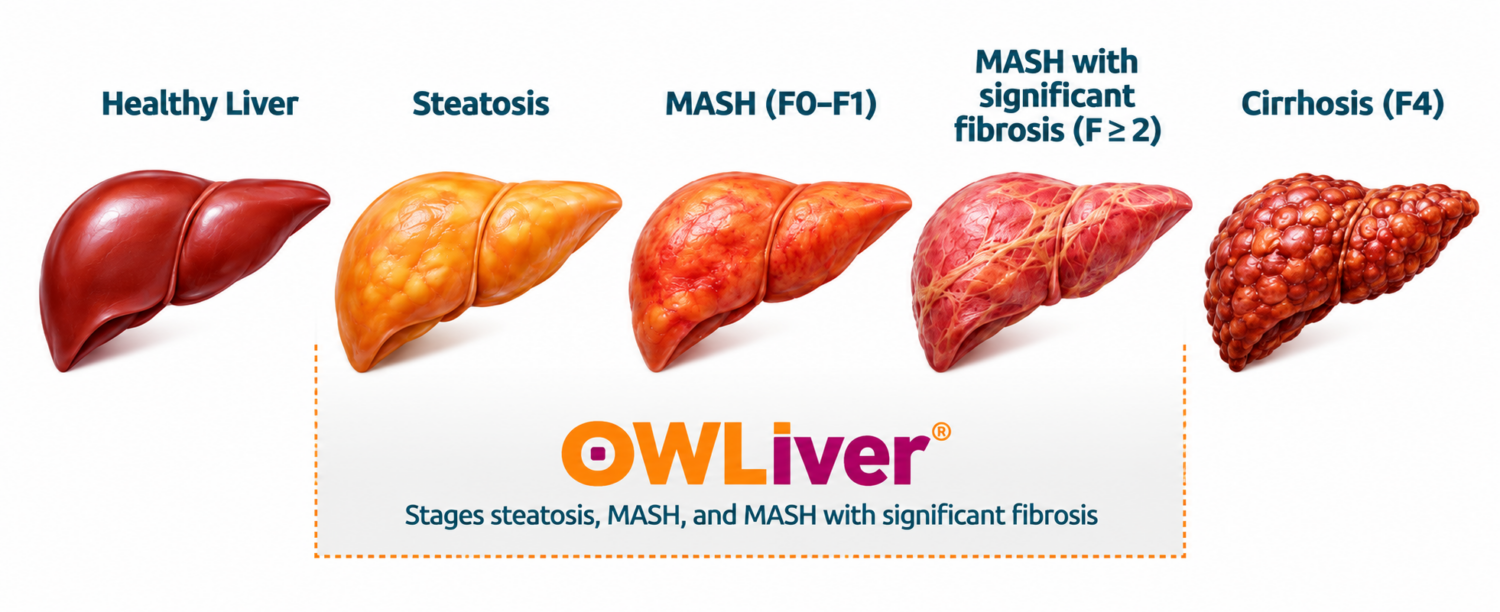
MASLD can progress from excess fat in the liver (steatosis) to metabolic dysfunction-associated steatohepatitis (MASH), an inflammatory form of the disease, and to clinically significant fibrosis. Within LITMUS, at-risk MASH was defined as MASH with fibrosis stage F2 or higher, an important distinction as care teams seek to identify patients who may warrant further evaluation and management.
The findings are especially relevant to clinical-trial screening, where reducing unnecessary biopsies while identifying eligible patients is a priority. The LITMUS investigators identified OWLiver-MASH among several tests with favorable performance in this setting. In the study’s overall diagnostic analysis, performance varied among biomarkers; only one panel significantly exceeded the prespecified AUC benchmark for at-risk MASH, and no test met that benchmark for MASH alone.
LITMUS is a prospective multicenter diagnostic accuracy study that evaluated 30 noninvasive markers and panels against centrally scored liver biopsies among 1,590 adults at 37 specialist liver centers across 13 countries, advancing the evidence base for identifying clinically important stages of MASLD.
“LITMUS is one of the most rigorous evaluations of noninvasive liver tests to date, and it makes clear that finding patients with at-risk MASH takes a thoughtful, layered approach rather than any single test,” said Frank Amato, CEO, CIMA Sciences. “We are encouraged that OWLiver contributed biopsy-validated evidence in that effort, identifying these patients with a high rate of confirmed positives. As treatments for MASH reach patients, that is the role OWLiver is designed to play.”
OWLiver’s broader clinical role
OWLiver uses metabolomics-based blood testing to assess liver fat, inflammation and fibrosis-associated risk. The test is designed to characterize MASLD, early MASH (F0–F1) and at-risk MASH (F≥2). Its broader intended use draws on separate validation research; LITMUS evaluated OWLiver MASH and MASEF markers, not the full early-steatosis classifier.
About CIMA Sciences
CIMA Sciences, LLC advances noninvasive diagnostic technologies for high-prevalence medical conditions. OWLiver® is developed by Rubió Metabolomics and offered in the United States by CIMA Sciences. The OWLiver blood test uses metabolomics to help clinicians assess MASLD and MASH across clinically relevant stages.
Sources: Vali et al., Lancet 2026;408:1850–1865, doi:10.1016/S0140-6736(26)01145-1.